The Turning Point In English Composition
This fall semester in English freshman composition challenged me to go beyond my limits in writing, especially when it came to analyzing different rhetoric in reading and writing genres for different audiences and purposes. Throughout this first semester, I recognized how each assignment was with purpose and connected to a bigger picture which was “Language Politics.” Significant learning moments include: how arguments can be expressed in different ways that are not formal writing, receiving reflective feedback from peers and the professor, being presented with authors who discussed the topic of language and cultural identity who then influence my own writing, and enhancing my argumentative skills in my synthesis essay.
Creating Translation 2 deepened my understanding of the politics of language and how we developed our own experience through different ways of writing. In my Translation 2, I used images to portray how students from different backgrounds are negatively impacted in English classrooms by linguistic expectations to speak proper English. This hinders 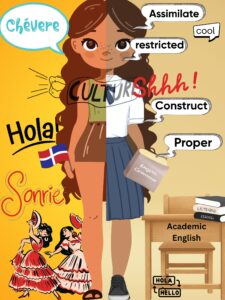 their confidence in belonging to their culture. I demonstrated this by having a Dominican girl, one side with vibrant colors,her flag in one hand and words in Spanish. The other side represents her being in an English classroom, where the colors are washed out, being restricted to speak her language and holding an English grammar book to replace her culture’s flag.
A poem I found that resonated with my story was Denice Forham’s spoken word poem, “Accents.” Forham’s mother would speak English, her accent would come through and be known for not speaking good English. But Forham says her mother’s accent is the pride of her country. “So even though her lips can barely stretch themselves around English, Her accent is a stubborn compass Always pointing her Towards home” (Forham 2014). Forham helped me realize how important Language Politics is, especially for immigrants in America who struggle with expressing themselves due to having an accent when speaking .
When working through my pieces of writing, I learned the importance of receiving feedback on my writing. Getting feedback showed me different perspectives on my writing and helped me understand how to go more in depth. For my Synthesis essay I had 1 on 1s with Professor Macagnone, where she gave me feedback on how to correct my sentences to make it clearer. For example, she said that my “Thesis needs clarification.” Revising; “English classrooms should allow more linguistic and cultural diversity within the classroom, which will increase the attendance of immigrant students in schools across America.” to “I argue that schools should encourage more linguistic and cultural diversity within the English classroom, which will increase the confidence of diverse students in schools.”
During our Translation 1 peer review in class, I saw the change in my writing go from one dimensional to two dimensional when receiving feedback from my peers in class. In my “Two and One poem” I added more about the parts that made me Dominican, like cooking and music, that added more depth to my writing: “When the aroma of Arroz con Pollo y Habichuela fills the kitchen, which my mother does religiously. Or the pride, the countless pride of our flag in the streets. All that is heard can be true, I still wish I could be considered one in two.” I realized the importance of not only receiving feedback in my writing but how I can use words to go deeper into the experiences I have with language, specifically belonging to two different cultures.
When reading about the experiences authors of immigrant parents experienced like Amy Tan, motivated me to write about my own experience with language. Amy Tan, a Chinese American author, wrote about her experience being a daughter of immigrant parents in America and the challenges that came with language acquisition. In Amy Tan’s “Mother Tongue,” Tan wrote about how her mother went to the hospital. While Tan believed her mother spoke “very good English,” the hospital thought otherwise. The hospital did not assist Tan’s mother until they called Tan “who spoke in perfect English”(78). I related to Tan’s story, as I’ve had to speak up for my mother especially in spaces where speaking English is challenging for her. When ordering food my mother’s English does not always come through or can be difficult to understand: “I smiled, knowing I only didn’t just help her but became that bridge she needed, the voice that spoke up for her when her English couldn’t.” Just like Amy Tan stood up for her mother and was able to break the barrier of languages, I understood how crucial it is for me to be the voice for my mother when hers is limited.
Starting my Synthesis essay I was very hesitant when it came to writing the essay due to feeling unsure if I was going to meet the expectations. Learning how to properly integrate sources for evidence helped me strengthen my argument and general understanding of the material.. While learning how I can use sources in my synthesis essay to back up my argument. The Synthesis proposal worksheet helped me narrow down my topic being about immigrant students facing conflict in English classrooms. Using sources like “It’s Different Lives”: “A Guatemalan American Adolescent’s Construction of Ethnic and Gender Identities across Educational Contexts” by Lucila D. Ek and “Terms of Inclusion: Has Multiculturalism Redefined Equality in American Education?” by Michael R. Olneck, to support how I advocated for students who faced challenges in English Classes.
This semester I received a greater understanding in expressing my personal experiences and ideas on an academic level. I did this by writing about how language is a part of our daily lives and can challenge our cultural identity. By practicing various techniques through my essays, poetry or through visual arguments, showing my understanding of the importance of Language within and outside of the classroom, and being introduced to Language Politics has proven to me that my writings can be a voice to many others who struggle to speak English or are labeled as unintelligent because of their dialect. Especially as someone who is majoring in English Education, where I can motivate the minds of young people to have pride in their culture at an academic standard.

